
Sarga vs Ashiatsu: What's the Difference (and Which Should You Learn)?
Nov 08, 2026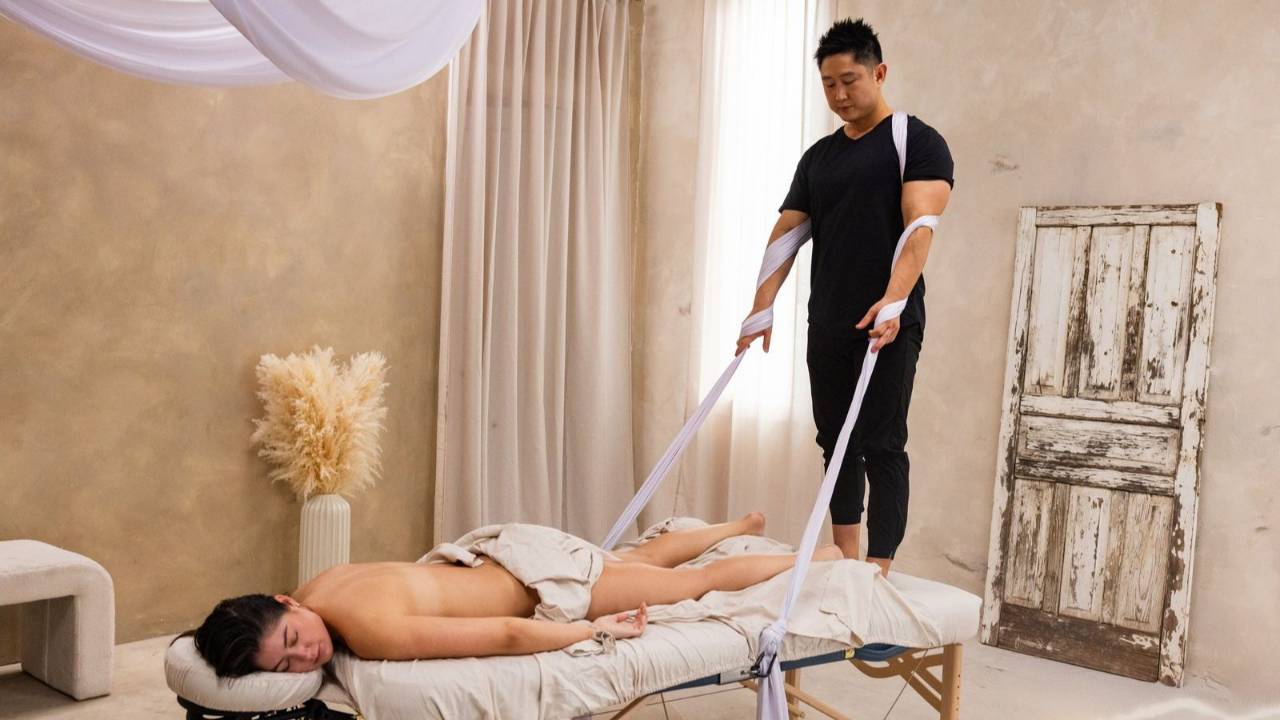
If you're looking into barefoot massage training, two names keep showing up: ashiatsu and Sarga.
They both use the feet. They both go deep. And in a quick clip, they can look pretty similar.
I've trained in both. I completed Ashiatsu Levels 1, 2 and 3, trained in Sarga 101 and 102, and now I teach Sarga to therapists in Nevada, California, and Texas. I'll be upfront: I chose Sarga, I teach it, and I think it's the strongest barefoot system out there for a lot of therapists. Ashiatsu is great work too. Here's what each one is, where they overlap, and why I went all in on Sarga.
I chose Sarga, I teach it, and I think it's the strongest barefoot system out there for a lot of therapists.
What is ashiatsu?
Ashiatsu means "foot pressure" in Japanese. Barefoot massage goes back a long way in parts of Asia and India. The ashiatsu most therapists in the U.S. learn today comes from Ruthie Hardee, who started Ashiatsu DeepFeet Bar Therapy in 1995 after years of deep tissue work strained her own back.
In Western ashiatsu, the therapist stands on the table and holds parallel bars mounted overhead for balance and support. The strokes are broad, deep, and flowing. They're done with oil or cream so the feet can glide.
Hardee has described the method as "gravity-assisted effleurage." That's the Swedish side of the work, and it's central to how Western ashiatsu feels. Long, gliding strokes. A Swedish-style rhythm, done with the feet instead of the hands. Western massage foundations show up in the stroke quality, the lubrication, and the continuous flow from start to finish.
Bars can be installed in the ceiling. Some ashiatsu schools also sell portable bar systems, so the work isn't locked to one room.
What is Sarga Bodywork?
Sarga Bodywork was created by Jivatma Massaguer and Daniel Tsukayama, seasoned bodyworkers based on O'ahu, Hawai'i. It's been around for years, and therapists across the U.S. and beyond now train in it.
Sarga needs no bars at all. Instead, it uses a length of fabric (the Sarga Silk) fastened to the massage table or a floor mat with patented hardware. You pull up on the strap while your foot presses down. That gives you stability and extra force at the same time.
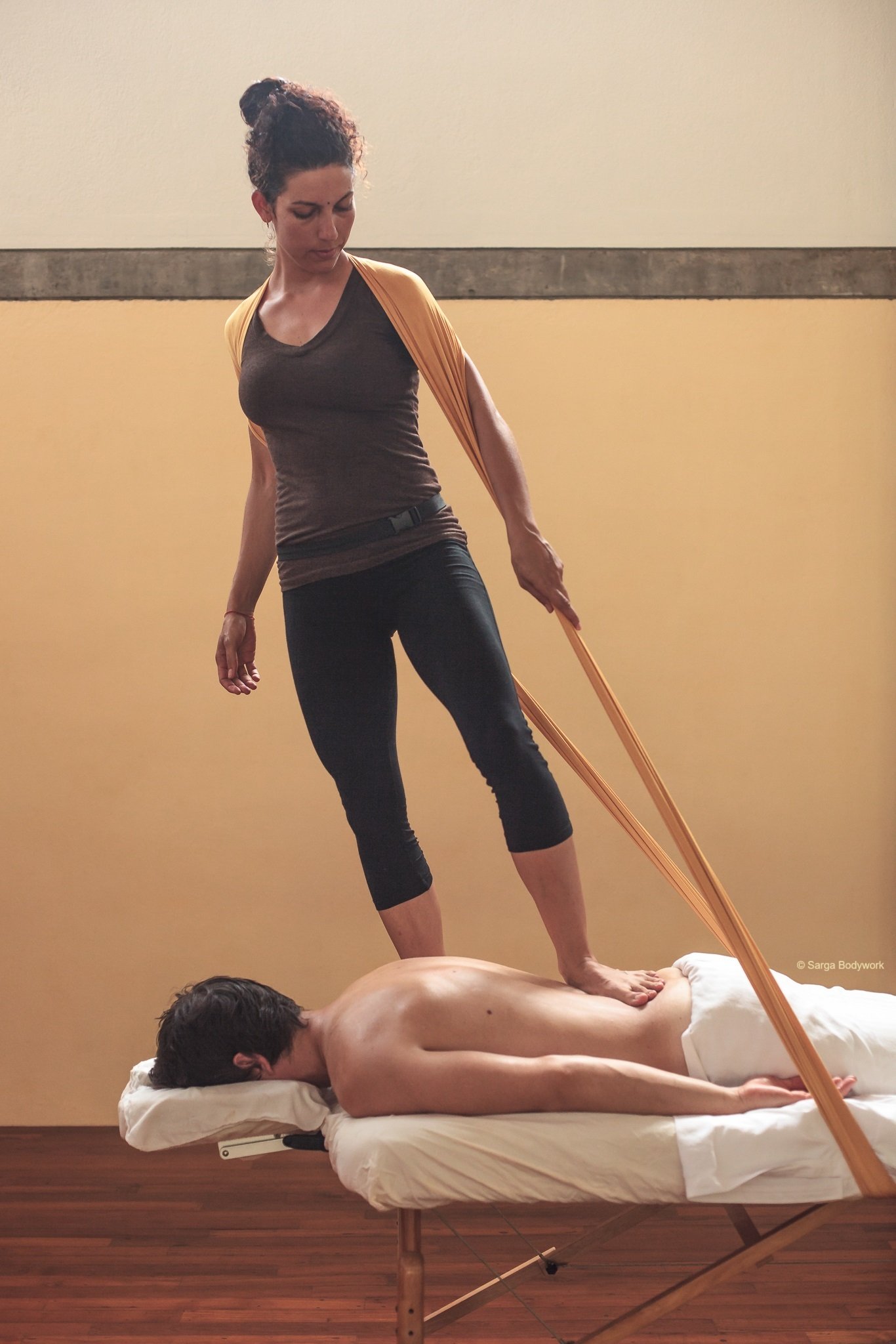
The work itself is true myofascial work. Sarga defines its technique as slow, sustained, oblique, high-tack contact. In plain terms: you move slowly enough to stay behind the tissue, you work at an angle instead of straight down, and you use very little lubricant so the foot grips the tissue instead of sliding over it.
Every technique is done with one foot at a time on the client. Your full body weight is never all on them.
You can see what the four-day course covers, day by day, on my Sarga Bodywork 101 training page.
Where Sarga and ashiatsu overlap
- Both use the broad surface of the foot, which spreads pressure out instead of digging in with a thumb or elbow.
- Both use gravity and body weight, so the therapist's hands and wrists aren't doing all the work.
- Some of the footwork strokes look and feel similar.
- They share the same basic contraindications as deep tissue work. ABMP lists things like pregnancy, blood pressure issues, acute injury, advanced osteoporosis, recent surgery, and certain medications.
Sarga also openly credits ashiatsu. Its FAQ says its instructors have background in the ashiatsu pioneered by Ruthie Hardee, along with Thai massage, barefoot shiatsu, and Chavutti Thirumal, and that Sarga draws inspiration from those lineages.
Why I chose Sarga: the real differences
No ceiling bars, fully mobile
This is the big one for most therapists. Ashiatsu gets stability from bars above you. Sarga gets it from a strap fastened to the table below you, so there's nothing to install in the ceiling.
Sarga has setups for raised tables and for floor-based tables and mats. The official site calls its newest board its most portable setup yet.
That means you can work in a rented room, a clinic, a spa, or a client's home. If you move studios, your setup moves with you.
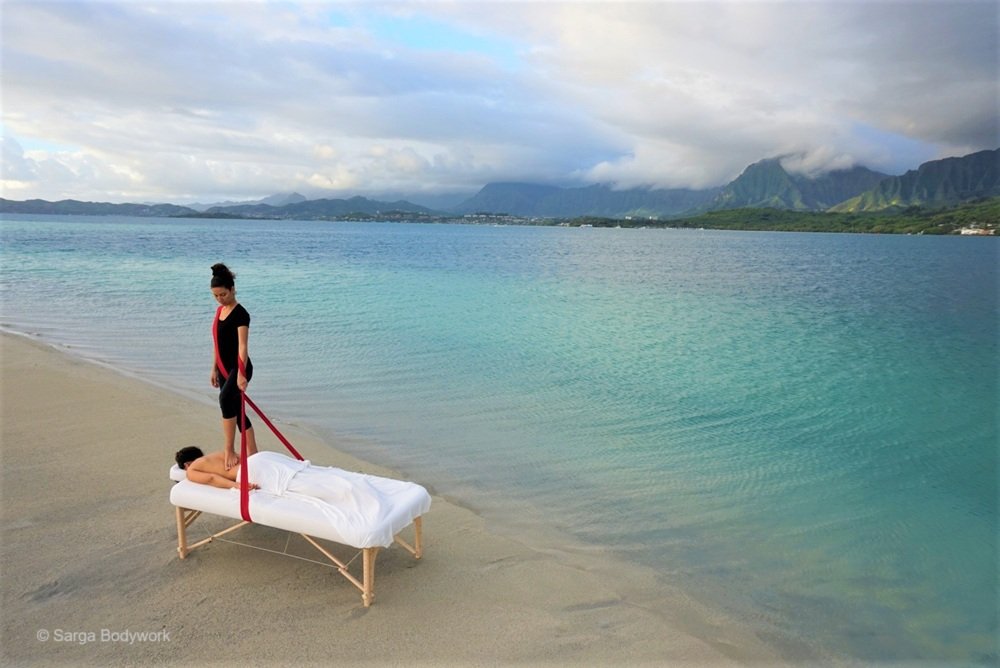
Sarga needs no bars at all. The strap fastens to the table, so your setup moves with you.
True myofascial work
Ashiatsu leans toward long, flowing, gliding strokes with lubricant, and clients love that. Sarga is built around myofascial work from the ground up: slow, sustained, angled strokes with a high-tack cream (Myo.Rub) so the foot can actually grab and stretch the fascia.
Sarga describes the goal as a systematic, full-body "combing" of the connective tissue.
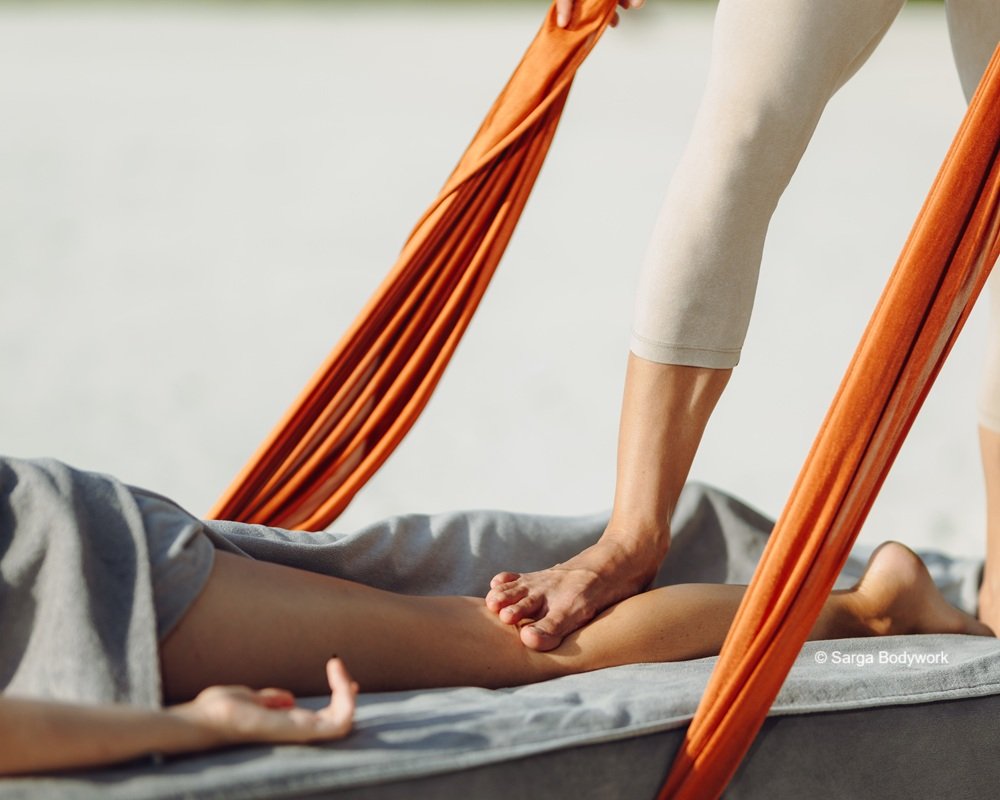
In my experience, that's the biggest difference in how the session feels.
Concepts of structural integration
Sarga draws on concepts of structural integration, specifically some of the theories behind Ida Rolf's work. The strokes are directional. They're applied in specific directions with the aim of helping reverse patterns of structural inefficiency in the body.
Sarga is careful to say it isn't a form of Structural Integration. That thinking still gives every stroke a purpose and a direction.
More pressure on tap
Here's how I see it. In ashiatsu, the bars help you control how much of your weight goes into the client. With Sarga, the strap lets you add force on top of your body weight.
Sarga's own FAQ says the Silk "allows practitioners to generate additional force beyond bodyweight," which is why they're strict about table weight limits.
Quick comparison
| Ashiatsu | Sarga Bodywork | |
|---|---|---|
| Support | Overhead parallel bars (installed or portable) | Fabric strap fastened to the table or mat, no bars |
| Main stroke style | Broad, flowing, gliding strokes (gravity-assisted effleurage) | Slow, sustained, directional myofascial strokes |
| Feel and foundations | Swedish-style rhythm, oil or cream for glide, Western massage stroke quality | High-tack contact, myofascial technique, concepts of structural integration |
| Lubrication | Oil or cream for glide | Sparing, high-tack cream |
| Setup | Ceiling bars or portable bar system | Raised table or floor setup with strap hardware |
Which barefoot massage training should you learn?
It comes down to the kind of work you want to do and where you want to do it.
Ashiatsu might be a better fit if...
- You already have a room where bars can go in, or you like the idea of a dedicated barefoot room.
- You love long, flowing strokes and a gliding Swedish-style rhythm.
- You want a well-established method with a long training history in the U.S.
Sarga is probably your fit if...
- You don't want ceiling bars, or you work in more than one location.
- You want true myofascial work with more pressure on tap.
- You like the idea of directional work grounded in concepts of structural integration.
- You already work on the floor (like Thai massage) or want a floor option.
- You meet the fitness bar. Sarga asks that you can balance on one foot for a minute, hold a plank for a minute, do three sets of twenty squats, and do ten to fifteen minutes of cardio without stopping. Raised table courses also have height and weight guidelines, with floor courses as an option.
Some therapists end up doing both.
What about CEUs and certification?
My Sarga 101 is a four-day, in-person course worth 35 NCBTMB-approved CEUs (provider #1431). Certification is a separate, optional step after that. Ashiatsu programs have their own CE approvals, so check with the provider you're looking at.
One more thing for therapists thinking about income
A specialty gives clients a clear reason to pick you. For me, barefoot work was that reason. I made $124K in card sales in my first full calendar year, on one massage table.
The modality was part of it. How I priced it mattered just as much. If that side of things is on your mind, I'm building The $100K LMT Pricing Course for massage therapists, and you can join the early access list here.
Want to try Sarga for yourself?
If you want barefoot work with no bars, true myofascial technique, and a system you can take anywhere, get your feet on a table. I teach small Sarga 101 groups, eight students max, in Nevada, California, and Texas.
Ready to train? Small groups. Real table time. No bars required.
See upcoming Sarga 101 dates and locationsREADY TO LEARN? START HERE.
3 Free Barefoot Technique Demos
Want to see how barefoot massage will transform your practice? I'll teach you techniques you can use right now. No special equipment needed.
We hate SPAM. We will never sell your information, for any reason.
Author

